Moving to Cramlington: A Guide to Living in the Town
Estates, new homes, Manor Walks, schools, the GP and hospital, councils, transport, leisure and jobs: a practical guide to moving to Cramlington, the south-east Northumberland new town.
Cramlington sits in south-east Northumberland, north of Newcastle and on the boundary with North Tyneside, with the A1, the A19 and the A189 all close by. It is a planned town built around an old mining village, and with 28,845 residents at the 2021 Census it is one of the largest towns in the county. This guide covers what you need to know before you move: the estates, the new housing, the town centre, schools, health services, the two councils, getting about, leisure and work.
A new town around an old village
For centuries Cramlington was a small agricultural and then coal mining settlement. The manor is first recorded in 1135, and the pits that opened in the 19th century drew workers into colliery rows and terraces. That changed in the 1960s, when Northumberland County Council chose Cramlington for a new "township". Unlike the government New Towns there was no development corporation: the plan, approved in 1963, relied on private housebuilders, with William Leech and J.T. Bell building most of the early homes.
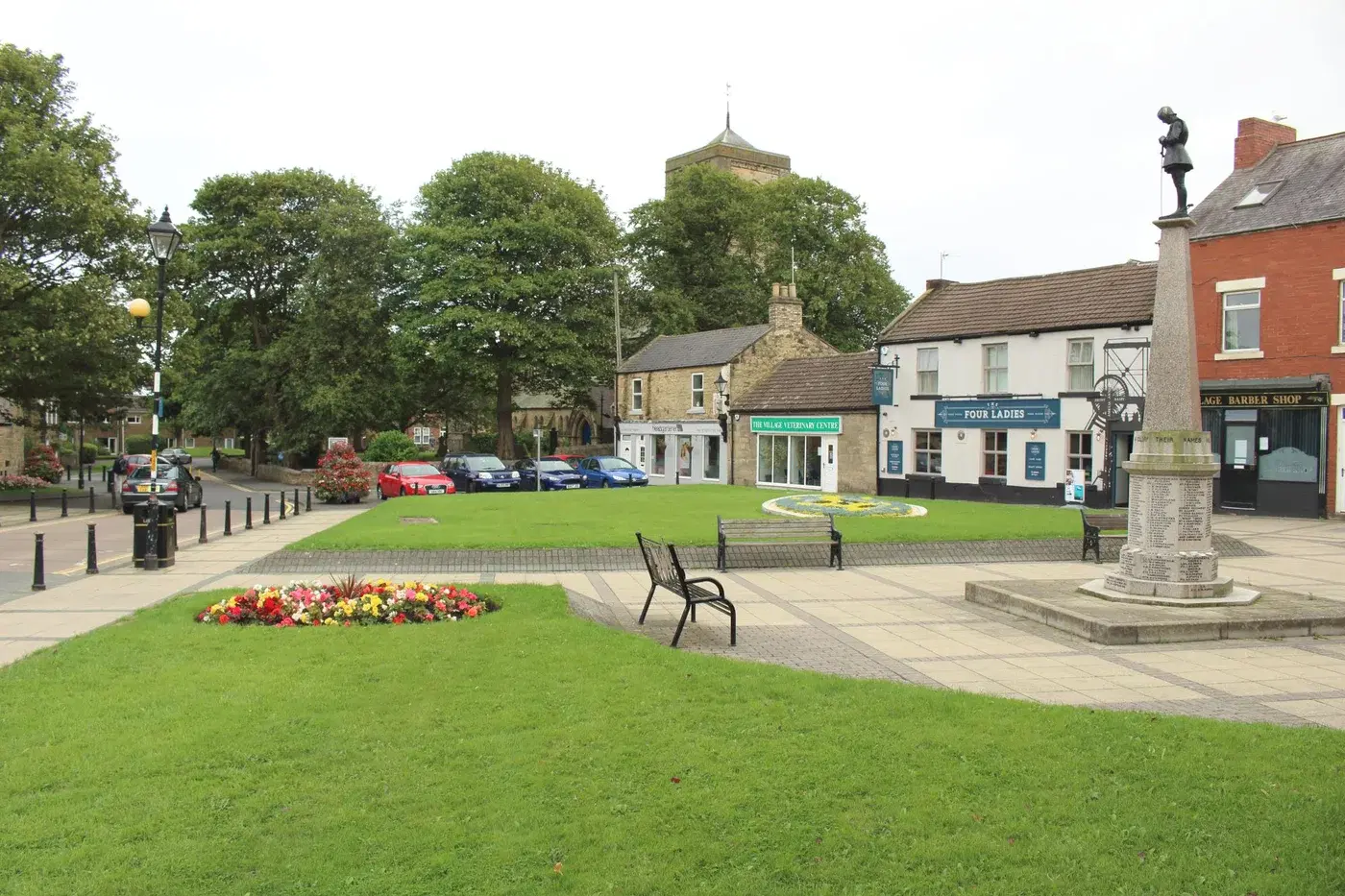
The old village survives at the heart of the town. Around the green and war memorial you will find stone cottages, a pub and small shops, with the tower of St Nicholas Church, completed in 1868, rising behind them. Our guide to historic churches in Cramlington has more on the town's older buildings.
Best for:
Cramlington was laid out with an extensive network of cycleways and footpaths separated from the roads, often running through underpasses. It is worth learning the routes near your new home: they are often the quickest way to school, the shops and the parks on foot or by bike.
The estates and neighbourhoods
The new town was built as a series of estates, each with its own housing and local green spaces, and many are named after their position in the town. Among the names you will see on maps and estate agents' listings are Beaconhill, Collingwood, Eastfield, Mayfield, Shankhouse, Southfield and Whitelea, along with Parkside (built in the 1970s), Westwood (early 1980s) and Northburn (late 1980s and 1990s). Each has a mix of terraces, semis, detached houses and bungalows, typically arranged in closes and cul-de-sacs off a main distributor road.
Older settlements sit around the edges. Klondyke, near High Pit Road, has terraced streets from around 1900 and is one of the oldest parts of the town. East Cramlington lies east of the A189 on the road to Seaton Delaval, Nelson Village gives its name to the Nelson industrial estates, and East Hartford, a former colliery village, is just north of the town. Annitsford, on the southern edge, is in North Tyneside rather than Northumberland, which matters for council tax, bins and school admissions.
For a closer look at each area, with house prices, schools and green space, see our guide to the best areas and streets to live in Cramlington.
Best for:
Check which council an address falls under before you buy or rent. Most of Cramlington is in Northumberland, but streets close to Annitsford and the southern boundary can be in North Tyneside.
New homes and the South West Sector
Cramlington is still growing. The largest scheme is the South West Sector, a long-planned extension to the south-west of the town that was first allocated for housing in 1999. An outline application submitted in 2015 for Persimmon and Bellway covered about 86 hectares and up to 1,600 homes. Building has gone on in phases since then, at developments including Arcot and Hartford Edge, with several housebuilders active, and further reserved-matters applications for land near White Hall Farm and Beacon Lane were still coming forward in 2026.
There are smaller new-build sites elsewhere too, including in East Cramlington. If you are buying new, check the council's planning register for what has been approved around the plot, and ask the developer about road adoption, management charges for open space and the timetable for any community facilities promised in the planning consent.
Older homes on the original estates often need a new boiler, a rewire or an extension once you move in. Our guide to finding a good tradesperson in Cramlington covers the checks to make, and we have local shortlists of plumbers, electricians and builders.
If you are buying or renting in the town, our guide to estate agents in Cramlington covers the three high-street branches. For conveyancing, see solicitors in Cramlington. For pension or investment advice, see financial advisers in Cramlington.
Manor Walks and the town centre
The town centre is Manor Walks, a covered shopping centre built in the 1970s and later extended, with the South Mall opening in 2013. Close by on Forum Way are the leisure centre and the Cramlington Hub, which houses the library and a council customer service point, and there are retail parks and supermarkets around the centre. In 2016 Arch, the county council's development company, bought Manor Walks for £78 million and later the neighbouring Westmorland Retail Park. Advance Northumberland, the council's regeneration company, is now the landlord.
In July 2026 Advance Northumberland held public drop-in sessions on early ideas for the centre's future, drawn up with GSSArchitecture. They include a new western mall entrance and a town square for community events. These are early concepts for a longer-term vision rather than an approved scheme, so expect further consultation.
Separately, the county council's £3.5 million Cramlington Regeneration Programme has been funding improvements across the town since late 2024, starting with cycleways and footpaths. It has also paid for a new activity trail in Alexandra Park, a dementia garden and a new youth facility being delivered by Cramlington Town Council with the Cramlington Voluntary Youth Project.
Best for:
For food and drink in and around the centre, see our guides to coffee shops and cafes, restaurants and pubs, or browse the eat and drink hub.
Schools
Cramlington uses the two-tier system, so children go to a primary school from four to 11 and then to secondary school. The town's secondary is Cramlington Learning Village on Highburn, an academy for students aged 11 to 18 with a sixth form. It was selected for the government's School Rebuilding Programme, and building work on the new school began in September 2025.
There are primary schools across the estates. Apply for places through Northumberland County Council's school admissions pages, where you can also check catchment areas, and read each school's latest Ofsted report before you choose. Our schools hub lists the town's schools, school holidays in Cramlington has the term dates, and finding a tutor in Cramlington covers extra lessons, from maths to music and swimming.
Health services
Cramlington is home to the Northumbria Specialist Emergency Care Hospital on Northumbria Way, which opened in June 2015 as England's first purpose-built specialist emergency care hospital. Run by Northumbria Healthcare NHS Foundation Trust, it treats serious emergencies such as suspected stroke and severe chest pain, with emergency consultants on site around the clock. For problems that are urgent but not serious, Northumbria Healthcare says you may be seen more quickly at an urgent treatment centre, and NHS 111 can tell you where to go.
There are several GP practices in the town, including surgeries at the Health Centre on Forum Way, on Dudley Lane, and in the Northumbria Health and Care Academy building in the hospital grounds, where the Brockwell practice relocated from Northumbrian Road. Use the NHS website's GP search with your new postcode to see which practices cover your address and which are accepting new patients, and register as soon as you have moved.
The councils and everyday services
Northumberland County Council is the unitary authority, responsible for council tax, bins, planning, roads, schools and libraries. Your council tax band is set by the Valuation Office Agency, and you can check any property's band on GOV.UK. Use your postcode on the county council's website to find your bin collection days. Cramlington Library and the council's customer service point are at the Cramlington Hub on Forum Way, next to the leisure centre.
Cramlington Town Council is the local tier. It covers seven wards and looks after local projects such as Coronation Park and the new play equipment in Alexandra Park. Councillors have held drop-in sessions at Manor Walks where residents can raise issues without an appointment. Our guide to council services in Cramlington covers both councils in more detail, and the practical info page gathers the essentials.
Getting around
Cramlington station, which opened in 1847, is on the East Coast Main Line, with Northern trains to Newcastle and north to Morpeth. Buses link the estates with Manor Walks, Newcastle, Blyth and the surrounding towns, and Newcastle International Airport is about 12 miles away. By road the A19 runs along the southern edge to the Tyne Tunnel, and the A1 is a short drive west.
For timetables, routes and fares, see our guide to getting around Cramlington without a car, and for the town centre car parks, where to park in Cramlington. If you or your teenagers need to pass a driving test, see learning to drive in Cramlington, and if you drive electric, EV charging in Cramlington.
Leisure and green space
Concordia Leisure Centre on Forum Way has been the town's leisure hub since 1977. It has a large free-form pool, a gym, studios, a sports hall, squash, bowling, soft play and a spa, and runs swimming lessons for all ages (see our swimming guide). The sport hub covers local clubs.
Green space is never far away. Northumberlandia, the landform sculpture on the western edge, Plessey Woods Country Park on the River Blyth and Alexandra Park in the town are all covered in our guide to parks and green spaces in Cramlington, and families should look at the best playgrounds and the families hub.
Joining a local group is one of the quickest ways to settle in. Our guide to volunteer groups in Cramlington covers the foodbank, Friends of Valley Park and the town's litter pickers, and if you want to grow your own, join the allotments waiting list early, as the average wait is around two years.
Best for:
New to the area? The things to do and outdoors hubs are a good place to start exploring, and the heritage hub covers the town's mining past.
Work and employment
Cramlington was planned as an industrial town as well as a residential one, and it remains an important employment centre. The main industrial zones lie to the north-west of the town, including the Nelson Park, South Nelson and Windmill estates, and there are newer offices at Northumberland Business Park. They are home to manufacturing, engineering and logistics firms of all sizes.
Pharmaceuticals are a particular strength. Organon's manufacturing site on Shotton Lane began production in 1975, and the former Aesica plant nearby, also on Shotton Lane, was bought by Pharmaron in 2022. The hospital is another major employer, and Newcastle and North Tyneside are within commuting distance by road and rail. If you are bringing a business with you or starting one, our guide to business support in Cramlington covers funded advice, grants and where to find office space.
Moved to Cramlington recently, or spotted something we should update? Get in touch.
Local businesses mentioned
Concordia Leisure Centre
Forum Way, Cramlington, Northumberland, NE23 6YB
St Nicholas' Church
Blagdon Terrace, Cramlington, Northumberland, NE23 6QQ
Cramlington Learning Village
Highburn, Cramlington, Northumberland, NE23 6BN
Northumbria Specialist Emergency Care Hospital
Northumbria Way, Cramlington, Northumberland, NE23 6NZ
Never miss what’s on
Join the weekly Cramlington.live digest — the best events, news and local tips, straight to your inbox. One email a week.
What's On
Remembrance Sunday in Cramlington
10:00 AM · St Nicholas Church, Blagdon Terrace, Cramlington NE23 6QQ
The Carrivick Sisters at Cramlington Folk Club
8:00 PM (doors 7:30 PM) · The Benedictine Social Centre, Glenluce Drive, Southfield Green, Cramlington NE23 6YA
Wilder Wellbeing at Northumberlandia
11:00 AM - 2:00 PM · Northumberlandia, Blagdon Lane, Cramlington NE23 8AU