Historic Churches in Cramlington
A guide to Cramlington's historic churches: the Grade II listed St Nicholas' in the old village with its Victorian glass and Georgian table tombs, the Belgian-inspired St John the Baptist at Annitsford, the 1893 Welcome chapel and the new town's St Paul's.
Cramlington is best known as a 1960s new town, but its churches tell a much longer story. Christians have worshipped in the old village since the 12th century, the coal boom of the 19th century brought a new parish church and chapels for the mining families, and the new town added a church of its own in 1970. This guide covers the buildings worth seeking out, from two Grade II listed Victorian and Edwardian churches to a chapel that has served the same congregation since 1893.
All of the churches below are working places of worship, so check opening times before you visit and be respectful during services. For more on the town's past, see our history timeline and the heritage hub.
St Nicholas' Church
St Nicholas' Church stands in the old village, a short walk from Village Square, and is Cramlington's Church of England parish church. It is listed at Grade II.
The site's history goes back much further than the present building. A register of Cramlington's chaplains begins with John the Clerk, around 1163 to 1180, who gave his name to the Wetherspoon pub on Low Main Place. Historic England records that the medieval chapel of St Nicholas, rebuilt in the late 17th century, stood a short distance south of today's church.
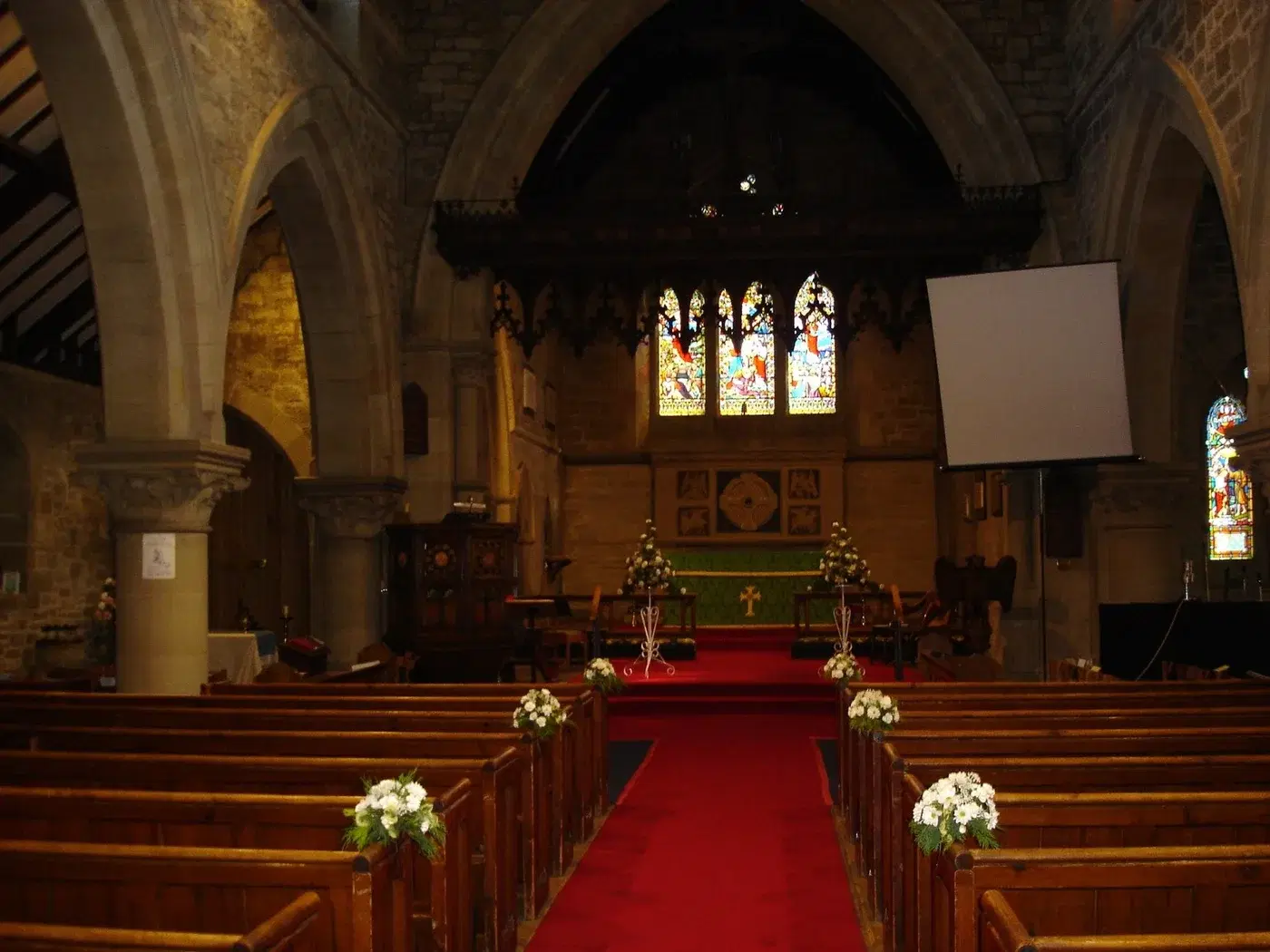
As the collieries grew in the 19th century, so did the village, and the old chapel was replaced. The present church was built in 1868 by the Newcastle firm of Austin and Johnson, adapting an earlier design by Dobson. The firm had taken over John Dobson's practice in 1865, which explains the connection. It is built of squared stone in what Historic England calls a "free 13th-century style", with a four-bay aisled nave, a tall three-stage west tower with a clock face, and a north porch with boarded doors and scrolled ironwork.
What to look for inside St Nicholas'
The nave arcades have pointed arches on round piers with foliage-carved capitals, a deliberate echo of late 12th-century work. Look east for the carved rood loft of 1896, with its hanging tracery, and below it a stone reredos carved with St Cuthbert's Cross and the symbols of the four evangelists, both visible in our photo above.
The aisles have stained glass of 1868 by Cottier, including the parable of the wise and foolish virgins. There are two fonts: a Romanesque-style font with inlaid marble panels, and a small 18th-century font in the north aisle with a cable-moulded bowl, which predates the present building. In the south aisle hangs a funeral hatchment of 1820 for Adam Mansfield de Cardonnel-Lawson, and by the font is an 1869 marble memorial to George Henry Shum-Storey, carved with an angel and a cross.
The churchyard
Three monuments in the churchyard are listed in their own right, all at Grade II, and they are among the oldest visible remains in the village. South of the church is a pair of 18th-century sandstone table tombs: one commemorates Michael Dunford (died 1726) and Catherine Errington, and the other, with fluted edges and carved flowers, Cuthbert and Hannah Turnbull (died 1778). A little further south is the table tomb of Ann Gray, dated 1762.
Against the south wall of the chancel is the headstone of Dorothy Gillespy, who died in 1776. Historic England singles out its carving of a hand holding a book in front of an arrow and trumpet, and its "good lettering".
St John the Baptist, Annitsford
At Annitsford, on the southern edge of town, the Catholic church of St John the Baptist is the area's other listed church, also at Grade II. A Catholic mission was founded here in 1863, and the present church was opened by Bishop Collins on 22 June 1906.
It is an unusual building for a Northumberland pit village. The parish priest, Father Chapman, took his Newcastle architect to Belgium, and the church is said to be modelled on the newly rebuilt cathedral at Ostend. It is in a French Gothic style, with a tall west front, a steep pyramid-roofed baptistery and an apse with an ambulatory behind the altar. Because of the risk of mining subsidence, it was built on a concrete raft. Inside, the timber furnishings were made by Belgian craftsmen, including a tall carved reredos with painted panels of saints and a pulpit with figures of saints in pinnacled niches.
Welcome Methodist Church
Methodism was strong in Cramlington's mining communities, and several chapels once served the collieries. The Welcome Methodist Church on Station Road, near the railway station, was built in 1893 as a Primitive Methodist church and has also been known as Station Terrace Methodist Church. Its congregation marked the chapel's 130th anniversary in October 2023.
St Paul's Catholic Church
When Cramlington was planned as a new town for up to 60,000 people, the Catholic diocese expected to need several churches. St Paul's at Dewley was the result: designed by the Newcastle architect David Brown and opened in July 1970. It is not listed, but it is a good example of the new town's architecture, in purple brick with a pitched steel roof and spirelet, and a mosaic and sculpture of the conversion of St Paul above the entrance. St Paul's and St John the Baptist now form one parish.
Further afield
Two village churches a few miles from Cramlington are worth adding to a heritage outing. Holy Trinity at Seghill, to the south-east, is a Grade II listed parish church of 1849 by Benjamin and John Green, with lancet windows in a 13th-century style. St Mary the Virgin at Stannington, to the north-west, was rebuilt in 1871 by R.J. Johnson, the same architect who worked on St Nicholas', and keeps the 13th-century north arcade of its medieval predecessor. It is also listed at Grade II.
Visiting
St Nicholas' holds Sunday services at 8am and 10.30am and is usually open on Sunday mornings and some weekday mornings; its A Church Near You page lists current times. There are public car parks nearby at Middle Farm Square and Smithy Square. The Catholic parish publishes Mass times for St Paul's and St John the Baptist on its website, and they change through the year, so check before you go.
Know more about the history of Cramlington's churches, or spotted something we should correct? Get in touch and we'll update the guide.
Local businesses mentioned
St Nicholas' Church
Blagdon Terrace, Cramlington, Northumberland, NE23 6QQ
St John the Baptist Catholic Church, Annitsford
Annitsford, Cramlington, Northumberland, NE23 7QR
Welcome Methodist Church
Welcome Chapel, Station Road, Cramlington, Northumberland, NE23 1EN
St Paul's Catholic Church
28 Dewley, Cramlington, Northumberland, NE23 6EF
Never miss what’s on
Join the weekly Cramlington.live digest — the best events, news and local tips, straight to your inbox. One email a week.
What's On
Remembrance Sunday in Cramlington
10:00 AM · St Nicholas Church, Blagdon Terrace, Cramlington NE23 6QQ
The Carrivick Sisters at Cramlington Folk Club
8:00 PM (doors 7:30 PM) · The Benedictine Social Centre, Glenluce Drive, Southfield Green, Cramlington NE23 6YA
Wilder Wellbeing at Northumberlandia
11:00 AM - 2:00 PM · Northumberlandia, Blagdon Lane, Cramlington NE23 8AU