Allotments in Cramlington: How to Get a Plot
How Cramlington's allotments work: the town council's 10 sites and 200-plus plots, the waiting list, how to apply, the main rules for plot holders, and discounts for over-65s and overgrown plots.
Growing your own fruit and vegetables is one of the most popular ways to spend time outdoors in Cramlington, and demand for plots is high. The town's allotments are run by Cramlington Town Council, which took them over from Northumberland County Council in 2009.
This guide explains how the system works, how long you can expect to wait, and the main rules you agree to when you take on a plot. We checked the details against the town council's website and its published Allotments Policy in November 2026.
Cramlington's allotments at a glance
| Detail | Cramlington allotments |
|---|---|
| Run by | Cramlington Town Council |
| Number of sites | 10 |
| Number of plots | More than 200 |
| Who can apply | Cramlington residents only |
| Waiting list | More than 50 people, with an average wait of around two years |
| How to apply | Application form, returned to the town council office |
| Contact | 01670 707 831 |
The council does not publish a list of the individual sites on its website. If you want to know which sites are nearest to you, or whether one site has a shorter list than another, ask the office when you apply.
Joining the waiting list
Allotments are for Cramlington residents only. To join the list, download the application form from the allotments page of the town council's website (cramlingtontowncouncil.gov.uk), fill it in and return it to the council office:
Cramlington Town Council, 27/28 Bamburgh House, 1st Floor, Manor Walks, Cramlington, NE23 6UT
If you cannot print the form, you can pick up a paper copy at the office.
The council says more than 50 people are waiting, and the average wait is around two years. If you ask for a particular site, you may wait longer. Under the council's policy the list is run in strict chronological order, so the date your form arrives is what counts.
Best for:
A plot can only be held in one name. If you plan to share the work with a friend or family member, decide whose name goes on the tenancy before you apply.
Rent and discounts
The allotment year runs to 31 March. The council sends invoices out 28 days before the new year starts, and rent is due by 1 April. The council does not publish its current rent on the website, so ask the office for the latest figure.
The policy includes some useful reductions:
- Starting part-way through the year: if you take on a plot by July you pay the full year's rent, and after July the rent is reduced pro rata.
- Overgrown plots: if a plot you are offered is very overgrown, the council can reduce the first year's rent by up to 50% to reflect the clearing work.
- Plot holders aged 65 and over get a 25% concession on their rent, on showing photo ID.
- Allotment associations: plot holders on a site can form an association by majority vote, with a Chair, Secretary and Treasurer. Plots on a site with an association get a 50% rent discount.
The main rules for plot holders
When you take on a plot you sign up to the council's Allotments Policy. The main points are:
- Keep it cultivated. At least 75% of the plot must be in cultivation.
- No business use. Allotments are for growing for yourself and your household. You cannot run a business from a plot or sell your produce.
- Buildings. You can have one shed, plus either a greenhouse or a polytunnel. Fences must be no higher than 5ft, and barbed wire is not allowed. No new pigeon lofts are permitted.
- Animals. Livestock (other than pigeons and cockerels) can only be kept with the council's permission. Cockerels are not allowed. Dogs must be kept on a lead and tethered.
- Firearms are banned on all sites.
The council has also published separate guidance on allotment fires, bonfires and composting. Read it before you light a bonfire or set up compost bins, because burning rules on allotments are a frequent source of complaints from neighbours.
Getting started once you have a plot
Most new plot holders find the first year is mainly about clearing and planning. A few tips:
- Clear in stages. Cover part of the plot with a weed-suppressing membrane while you work on the rest, rather than trying to dig everything at once.
- Talk to your neighbours. Experienced plot holders on the same site know which crops do well in that soil and what the pests are.
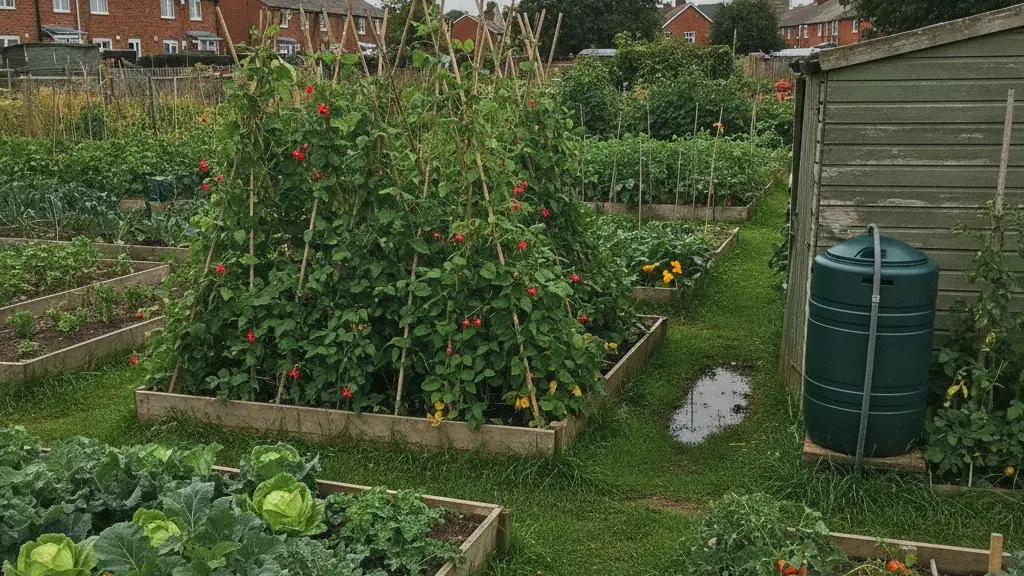
- Start with easy crops, such as potatoes, runner beans, onions, courgettes and salad leaves.
- Set up a water butt on your shed to collect rainwater.
Other ways to grow and garden in Cramlington
If you are on the waiting list, or don't have time for a full plot, there are other ways to get outdoors and grow things:
- Friends of Valley Park. The Friends of Valley Park volunteers meet every Thursday at 10am. Their work has included planting saplings and a community orchard in the park. See our volunteer groups guide for more.
- Coronation Park. In February 2025 the town council said that later phases of its Coronation Park project would include communal allotments and an orchard. We have not been able to confirm whether these have opened yet, so check with the council if you are interested.
- Garden centres. For seeds, tools and compost, garden centres within a short drive include Heighley Gate near Morpeth and Cowell's at Woolsington.
Related guides
For other council services, from bins to parking, see council services in Cramlington. Our parks and green spaces guide and best walks in Cramlington cover more ways to get outside, and newcomers will find an overview of the town in moving to Cramlington.
Spotted a change, or run an allotment association in Cramlington? Get in touch and we'll update the guide.
Local businesses mentioned
Cramlington Town Council
27/28 Bamburgh House, 1st Floor, Manor Walks, Cramlington, Northumberland, NE23 6UT
Friends of Valley Park
Valley Park entrance, Welbury Way, Cramlington, Northumberland, NE23 6PD
Heighley Gate Garden Centre
Gate, A697, Heighley, Morpeth, Northumberland, NE61 3DA
Cowell's Garden Centre
Main Road, Woolsington, Newcastle upon Tyne, NE13 8BW
Never miss what’s on
Join the weekly Cramlington.live digest — the best events, news and local tips, straight to your inbox. One email a week.
What's On
Remembrance Sunday in Cramlington
10:00 AM · St Nicholas Church, Blagdon Terrace, Cramlington NE23 6QQ
The Carrivick Sisters at Cramlington Folk Club
8:00 PM (doors 7:30 PM) · The Benedictine Social Centre, Glenluce Drive, Southfield Green, Cramlington NE23 6YA
Wilder Wellbeing at Northumberlandia
11:00 AM - 2:00 PM · Northumberlandia, Blagdon Lane, Cramlington NE23 8AU