Heritage Walking Trail: Cramlington Old Village
A self-guided heritage walk round Cramlington's old village: the 1922 war memorial, the Grade II listed Blagdon Arms, Georgian Cramlington Hall, Middle Farmhouse, St Nicholas' Church and its 18th-century table tombs, plus Hartford Bridge further afield.
Most of Cramlington was built from the 1960s onwards, but the old village at its heart is much older. Around Village Square and Low Main Place you can still find a cluster of listed buildings: an 18th-century hall, a farmhouse remodelled around 1800, an 18th-century inn, a Victorian parish church and a war memorial topped by a knight in armour. This self-guided trail links them up in a short stroll, with two older sites further afield for anyone who wants a longer day out.
The listing details below come from the official National Heritage List for England, which we read via the British Listed Buildings mirror. Several of the buildings are private homes, so please view them from the street.
1. The war memorial
Start at the war memorial in Village Square, on Low Main Place. It is listed at Grade II and is easy to spot: a tapering polished granite shaft carrying a wreath, standing on a stepped octagonal base, with a figure of a knight in armour holding a sword on top. The inscriptions are inlaid in lead. (Historic England list entry 1303677)
The Imperial War Museums' memorial register records that it was designed by Miss Margaret Wrightson of Neasham Hall, Darlington, and unveiled on 17 September 1922 by Lieutenant Colonel Robert Scott of Newton House, Lesbury, with the Bishop of Newcastle dedicating it. It carries 152 names from the First World War, 55 from the Second and one from Northern Ireland, under the words "Their names shall live forever in honour & glory". The knight's sword was replaced in 2007 and the memorial was cleaned and relettered in 2014. (IWM War Memorials Register; Co-Curate)
Best for: The listing gives a date of about 1919 for the memorial, while the IWM records the 1922 unveiling date.
2. The Blagdon Arms and its outbuilding
Also on Village Square is the Blagdon Arms, one of the oldest buildings on the trail and still a working pub. Historic England describes it as an inn of the late 18th or early 19th century with later 19th-century alterations, built in two parts. Look for the tooled stone front, the Welsh slate roof with red tile cresting on the left-hand section, three gabled dormers, and a corbelled hood over what was once a doorway. Inside, two original fireplaces survive, one with an old range. (list entry 1371415)
Behind it to the north-west is a separately listed outbuilding with an attached wall. It dates from the late 18th century, was remodelled in the 19th, and was a stable with a cartshed, a reminder of the old village's farming past. (list entry 1303640)
3. John the Clerk
Nearby on Low Main Place, John the Clerk is not a listed building, but its name is a piece of local history. John the Clerk is the first chaplain recorded in Cramlington, around 1163 to 1180, at the medieval chapel that stood a short distance south of today's St Nicholas' Church. Our guide to historic churches in Cramlington has more on the chapel.
4. Cramlington Hall
On the east side of Low Main Place stands Cramlington Hall, the grandest house in the old village and a private home. Historic England dates it to the mid-18th century and describes a Palladian house of squared stone with ashlar dressings. Its five-bay south front has a modillion eaves cornice and 12-pane sash windows. (list entry 1041355)
If you spot a datestone reading "A.D. 1100", don't be fooled. The listing itself calls it misleading, and the house was built in the mid-18th century.
5. Middle Farmhouse and The Plough
Middle Farmhouse is an early 18th-century house remodelled around 1800. It has a squared stone front of two storeys and three bays, with a central four-panel door set in a surround of alternating stone blocks. The garden walls to the south are listed too. (list entry 1041352; list entry 1303642)
The old farm buildings beside it have been converted into The Plough, so this is a natural place to stop for a drink before the last leg.
6. St Nicholas' Church and the table tombs
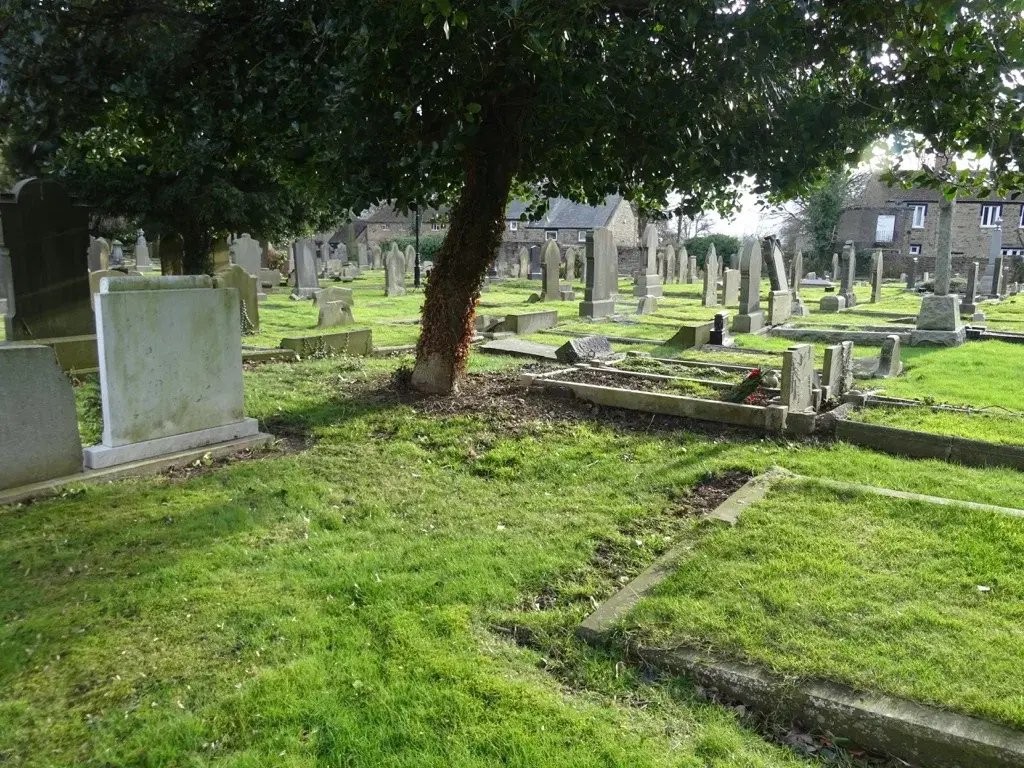
Finish at St Nicholas' Church on Blagdon Terrace. The present Grade II listed church was built in 1868 by the Newcastle architects Austin and Johnson, replacing the medieval chapel that stood a short distance to the south. (list entry 1371416)
The churchyard holds three listed 18th-century monuments, all just south of the church:
- The Gray tomb, a table tomb of 1762 to Ann Gray, carved with a coat of arms in a roundel and raised on six urn-shaped legs. (list entry 1041353)
- A pair of sandstone table tombs. The eastern one remembers Michael Dunford, who died in 1726, and Catherine Errington, widow of Lancelot Errington of West Denton. The western one is to Cuthbert and Hannah Turnbull, who died in 1778. (list entry 1154798)
These tombs are older than the church itself, so they once stood beside the earlier chapel. The church is a working place of worship, so check times before going inside.
Further afield: Hartford Bridge and the old windmill
For a longer outing, head out along the A192 towards Bedlington to Plessey Woods Country Park, which sits on the River Blyth at Hartford Bridge. The bridge is listed at Grade II. Historic England dates it to the 15th or 16th century, records that it was widened in 1688 and widened again and partly rebuilt in 1904, and notes its three segmental arches. (list entry 1041419) Our best walks in Cramlington guide covers the riverside routes through the woods.
Near the Plessey Checks roundabout is one more listed survivor: an old windmill about 700 metres south-west of the Plessey Checks roundabout. It is a roofless but intact shell, dated 1749 with the initials of Matthew White. (list entry 1041378) We have not been able to confirm whether there is public access to it, so treat it as one to look for from a public road or path rather than a stop on the trail.
Practical tips
- Parking and getting there: see our guides to where to park in Cramlington and getting around without a car.
- Private property: Cramlington Hall and Middle Farmhouse are private, so admire them from the street.
- Refreshments: the Blagdon Arms, John the Clerk and The Plough are all on or close to the route.
Further reading
For the bigger picture, see our Cramlington history timeline and the heritage hub. Our interesting facts about Cramlington covers the coal-mining and new town story, and lost buildings of Cramlington looks at the pits, aerodrome and airship shed that have vanished from the map.
Local businesses mentioned
St Nicholas' Church
Blagdon Terrace, Cramlington, Northumberland, NE23 6QQ
Blagdon Arms
Village Square, Cramlington, Northumberland, NE23 1DN
John the Clerk of Cramlington
2 Low Main Place, Cramlington, Northumberland, NE23 1DN
The Plough
Middle Farm Buildings, Middle Farm Square, Cramlington, Northumberland, NE23 1DN
Plessey Woods Country Park
Shields Road, Plessey, near Bedlington, Northumberland, NE22 6HZ
Never miss what’s on
Join the weekly Cramlington.live digest — the best events, news and local tips, straight to your inbox. One email a week.
What's On
Remembrance Sunday in Cramlington
10:00 AM · St Nicholas Church, Blagdon Terrace, Cramlington NE23 6QQ
The Carrivick Sisters at Cramlington Folk Club
8:00 PM (doors 7:30 PM) · The Benedictine Social Centre, Glenluce Drive, Southfield Green, Cramlington NE23 6YA
Wilder Wellbeing at Northumberlandia
11:00 AM - 2:00 PM · Northumberlandia, Blagdon Lane, Cramlington NE23 8AU