Lost Buildings of Cramlington
The Cramlington that has vanished: the medieval chapel of St Nicholas, the colliery pits and wagonway, the First World War aerodrome and flying club hangars, and the giant Nelson airship shed demolished in 1967.
Cramlington looks like a modern town, and most of it is. That is partly because so much of what came before has gone. The pits that made the village grow in the 19th century have closed and been landscaped, the aerodrome where the North East's first military pilots trained is now an industrial estate, and an airship shed big enough to build a passenger airship stood near Nelson Village until 1967. This guide gathers what is known about Cramlington's lost buildings, and what, if anything, you can still see.
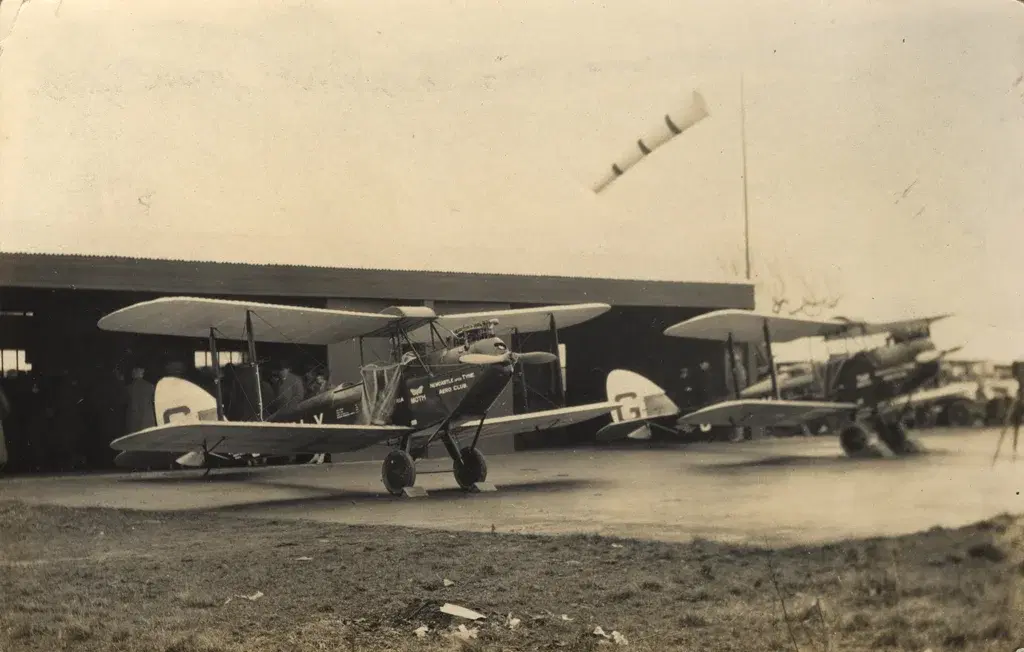
Our photo, from Newcastle Libraries' collection, shows Newcastle Aero Club's de Havilland Moths outside their hangar at Cramlington Aerodrome in 1925. Neither the hangar nor the airfield survives.
The medieval chapel of St Nicholas
The oldest lost building we know of is Cramlington's first church. A chapel of St Nicholas stood in the village from the Middle Ages, and Historic England records that it was rebuilt in the late 17th century and stood a short distance south of the present church. It was replaced when the colliery-era village outgrew it, and today's St Nicholas' Church was built in 1868. (Historic England list entry 1371416)
What survives from the old chapel's time are the 18th-century table tombs in the churchyard, which our heritage walking trail visits.
The colliery pits
Coal made 19th-century Cramlington. The Durham Mining Museum's records list a string of shafts belonging to Cramlington Colliery, each with its own name: the Anne Pit and the Engine Pit, both sunk in 1825; the Amelia Pit, sunk on 22 August 1847; the Richard Pit, sunk on 16 November 1849; and the Betsy and Lamb pits. (Durham Mining Museum: Cramlington Colliery) Northumberland County Council's community history notes that the Amelia Pit was at Shankhouse. (Northumberland Communities)
The colliery changed hands several times. In the 1880s it was owned by Joseph Lamb and Partners, by the 1910s by the Cramlington Coal Company, and from May 1929 by Hartley Main Collieries. Its decline was steep: the museum records 689 people employed in 1930, 526 in 1935 and just 11 in 1940. The Lamb Pit stopped drawing coal in November 1924 but was kept on for pumping and as a coal washery until 1955. (Durham Mining Museum)
There was a separate East Cramlington Colliery too, whose Dicky Pit was owned in the 1860s by Lamb, Potter and Scott. (Durham Mining Museum: East Cramlington)
The wagonway and the staiths
Coal from the pits needed a route to the river. The Cramlington Wagonway opened in 1823 and was extended to Shankhouse in 1847, Dudley in 1854 and East Hartford in 1866. (Tyne and Wear HER 1056) At its southern end were the Cramlington Staiths in Northumberland Dock at Howdon, where coal was loaded onto ships. They appear on the Ordnance Survey map of 1864, and by 1894 to 1895 one of them had been replaced. (Tyne and Wear HER 2112)
Cramlington Aerodrome
Cramlington's most surprising lost site is its aerodrome. The North East Land, Sea and Air Museums describe it as the first Royal Flying Corps station in the region. It was set up in response to German airship raids in 1915, and the Tyneside Home Defence flight was formed there on 1 December 1915, and No. 36 Squadron was formed at Cramlington on 1 February 1916. The airfield covered about 155 acres and had three flight sheds of the 1915 pattern. In April 1918 the Armstrong Whitworth Armadillo fighter made its first flight there. (NELSAM)
The military left soon after the war. Closure was announced on 6 November 1919 and completed on 22 January 1920. (NELSAM)
The flying club years
The airfield had a second life. The Newcastle upon Tyne Aero Club was formed in July 1925 and opened at Cramlington later that year. A storm in 1928 brought down the roof of the club's hangar. The aerodrome hosted air races and air displays, including a stop on the 1930 King's Cup Air Race. A local firm, Cramlington Aircraft Ltd, also worked from the site. (NELSAM; Wikipedia: Cramlington Aerodrome)
The end came when Newcastle's new airport at Woolsington opened on 26 July 1935. Most users had moved by May 1936, when Cramlington Aircraft ceased trading, and a gliding club stayed on until the Second World War began in September 1939. (Wikipedia: Cramlington Aerodrome)
Best for: Look for the site today on the Bassington Industrial Estate, which covers the old airfield buildings area. Part of the former landing ground was later taken over by the Shotton opencast coal mine. (Source: Wikipedia)
The Nelson airship shed
Half a mile or so east of the aerodrome, at Nelson Village, work began in 1918 on an airship station. Its huge shed was not finished until 1919, and the station was soon abandoned. A decade later the shed found a new use: British Airships Ltd assembled the AD.1, a small passenger airship, inside it. The AD.1 first flew on 18 September 1929 under the registration G-FAAX, but was destroyed in a storm in Belgium on 5 October 1930. (Wikipedia: Cramlington Aerodrome)
The shed went on to be used for making concrete lamp posts before it was demolished in 1967. Its site is now the South Nelson Industrial Estate. (Wikipedia: Cramlington Aerodrome)
Older still: the White Hall Farm roundhouses
Not every lost building was lost recently. In 2017, archaeologists excavating at White Hall Farm ahead of new housing uncovered an Iron Age settlement with roundhouses, evidence that people were living on the land long before the village of Cramlington existed. (Wikipedia: Cramlington)
Further reading
To see what has survived, follow our heritage walking trail round the old village, or read about the historic churches in Cramlington. Our interesting facts about Cramlington and famous people from Cramlington pick up more of the story, and the Cramlington history timeline and heritage hub bring it all together.
Local businesses mentioned
Never miss what’s on
Join the weekly Cramlington.live digest — the best events, news and local tips, straight to your inbox. One email a week.
What's On
Remembrance Sunday in Cramlington
10:00 AM · St Nicholas Church, Blagdon Terrace, Cramlington NE23 6QQ
The Carrivick Sisters at Cramlington Folk Club
8:00 PM (doors 7:30 PM) · The Benedictine Social Centre, Glenluce Drive, Southfield Green, Cramlington NE23 6YA
Wilder Wellbeing at Northumberlandia
11:00 AM - 2:00 PM · Northumberlandia, Blagdon Lane, Cramlington NE23 8AU