Oldest Pubs in Cramlington
The history behind Cramlington's oldest pubs: the listed Blagdon Arms, once the Blue Bell; the Travellers Rest beer house that became John the Clerk; the Plough in the old Middle Farm buildings; and an 18th-century coaching inn at nearby Stannington.
Most of Cramlington's pubs were built for the new town from the 1960s onwards, but three in the old village have histories that go back much further. One is a listed inn of around 1800, one began as a Victorian beer house, and one occupies old farm buildings. Cramlington's records are thin, so this guide sticks to what the sources actually say and flags where a date is uncertain. We have added one older inn just outside the town, at Stannington, for anyone who wants to make a day of it.
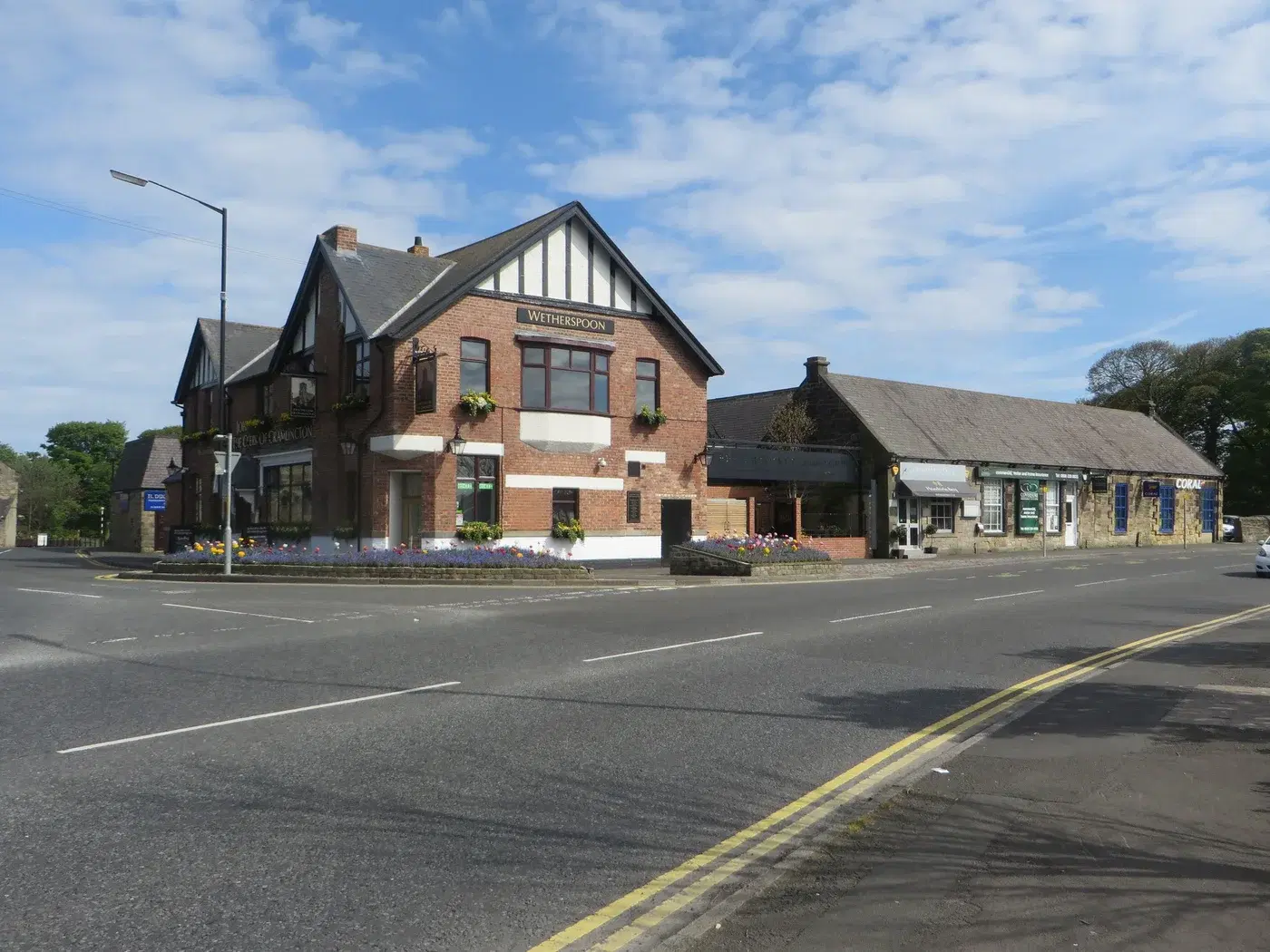
Our photo shows John the Clerk of Cramlington, the 1903 rebuild of the old Travellers Rest, on Low Main Place. For where to go for a pint today, including the newer pubs, see our guide to the best pubs in Cramlington.
The Blagdon Arms: the listed inn
The Blagdon Arms on Village Square is the only pub in Cramlington that we know to be in a listed building. Historic England describes it as an inn of the late 18th or early 19th century, with later 19th-century alterations, built in two parts. Inside, two original fireplaces survive, one with an old range. (Historic England list entry 1371415)
Behind the pub is a separately listed outbuilding of the late 18th century, remodelled in the 19th, that served as a stable and cartshed. It is a reminder that an inn of this age looked after horses as well as drinkers. (list entry 1303640)
CAMRA records that the pub's previous name was the Blue Bell. (CAMRA WhatPub) We have not found a reliable date for the change. The present name presumably refers to the nearby Blagdon estate, but we have not found a source that says when or why it was adopted.
Best for: The listing gives the building's age, not the pub's: we have not found when it first opened as an inn.
John the Clerk: from the Travellers Rest
John the Clerk of Cramlington on Low Main Place opened as a Wetherspoon in July 2013, but the pub on this site is much older. JD Wetherspoon's own history of the building says it was first mentioned in 1859 as the Travellers Rest, when the Morpeth Herald reported that "a Christmas supper was held at the house of Mrs Morris, Travellers Rest, Cramlington Village". (JD Wetherspoon pub history)
According to the same history, the Morris family still owned it as a beer house in 1871. Thomas Doughty was running it by around 1891, and in 1903 he applied to rebuild the old beer house as "The Travellers Rest Inn". The red-brick building with mock-Tudor gables that you see today is that rebuild. (JD Wetherspoon)
Its present name honours John the Clerk, the first recorded chaplain of Cramlington, who served the medieval chapel around 1163 to 1180. Our guide to historic churches in Cramlington has more on him.
The Plough: a pub in the farm buildings
The Plough at Middle Farm is a pub in very old surroundings. Its operator, Sir John Fitzgerald, says it "comprises the original farmhouse and steading", together with an unusual circular building that was once used to grind corn. (Sir John Fitzgerald: The Plough)
We have not found when the farm buildings became a pub, so we cannot say how long the Plough has been trading. The farm itself is old: the neighbouring Middle Farmhouse is listed as an early 18th-century house remodelled around 1800. (list entry 1041352) Our guide to historic trades and crafts in Cramlington has more on the village's farming past.
Best for: The Plough, the Blagdon Arms and John the Clerk are all within a few hundred metres of each other, so you can see all three on one short walk.
Further afield: the Ridley Arms, Stannington
For an old coaching inn, go a few miles north-west to Stannington, off the A1. The Ridley Arms is another Sir John Fitzgerald pub. CAMRA describes it as having "several distinct areas dating back to the 18th century". (CAMRA WhatPub)
Newcastle University's Co-Curate record of Stannington's buildings says it was built as a coaching inn on what was the Great North Road, and gives its date as "C18th?", with a question mark. The building is not listed, so treat the 18th-century date as reputed rather than proven. Next door is the Old Hearse House, dated 1871, which is listed at Grade II. (Co-Curate) The pub's name probably refers to the Ridley family of nearby Blagdon Hall, though we have not found a source that confirms it.
Today it serves food daily, has real wood fires and an enclosed terrace, and welcomes dogs in the bar. (Sir John Fitzgerald: The Ridley Arms)
Lost pubs
Not every old pub survived. Our best pubs guide records the newer pubs that have closed, and our guide to the lost buildings of Cramlington covers the pits and aerodrome whose workers once drank in the village.
Further reading
To see the old village pubs alongside its other listed buildings, follow our heritage walking trail. Our interesting facts about Cramlington, the Cramlington history timeline and the heritage hub tell the rest of the story.
Details were checked in November 2026. If you know more about the history of any of these pubs, get in touch and we'll update the guide.
Local businesses mentioned
Blagdon Arms
Village Square, Cramlington, Northumberland, NE23 1DN
John the Clerk of Cramlington
2 Low Main Place, Cramlington, Northumberland, NE23 1DN
The Plough
Middle Farm Buildings, Middle Farm Square, Cramlington, Northumberland, NE23 1DN
The Ridley Arms
Stannington, Morpeth, Northumberland, NE61 6EL
Never miss what’s on
Join the weekly Cramlington.live digest — the best events, news and local tips, straight to your inbox. One email a week.
What's On
Remembrance Sunday in Cramlington
10:00 AM · St Nicholas Church, Blagdon Terrace, Cramlington NE23 6QQ
The Carrivick Sisters at Cramlington Folk Club
8:00 PM (doors 7:30 PM) · The Benedictine Social Centre, Glenluce Drive, Southfield Green, Cramlington NE23 6YA
Wilder Wellbeing at Northumberlandia
11:00 AM - 2:00 PM · Northumberlandia, Blagdon Lane, Cramlington NE23 8AU