Historic Trades and Crafts in Cramlington
The work that built Cramlington: hewers, putters and screen boys at the colliery, the wagonway men who took the coal to the Tyne, the farms and windmill of the old village, and the factories that came with the new town.
For most of its history, Cramlington worked the land, and then for about a century it worked the coal under it. Since the 1960s it has worked in factories and offices. This guide looks at the trades behind each of those eras, using the records that survive: listed buildings, the Durham Mining Museum's colliery records and the county council's community history.
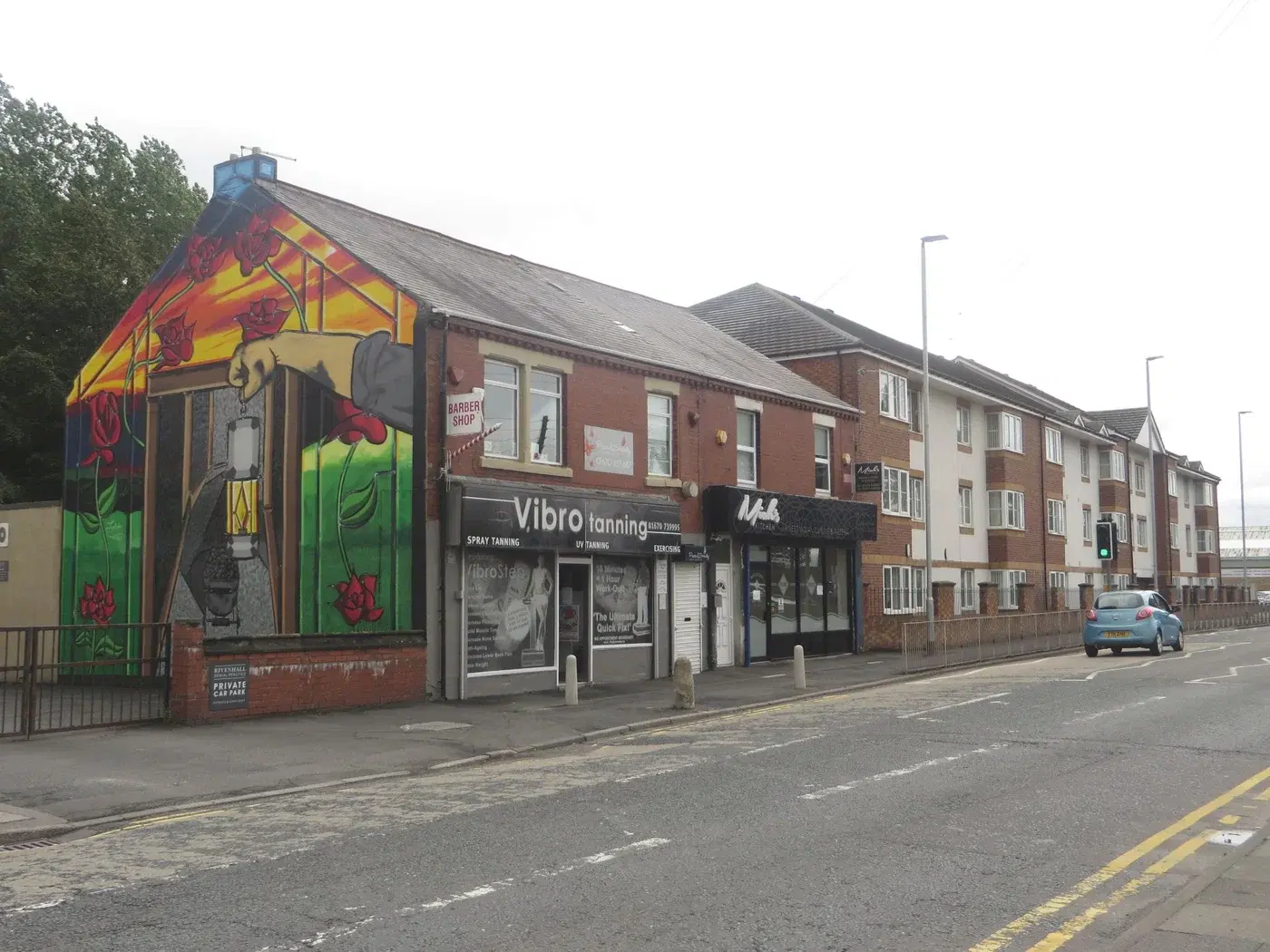
Our photo shows a gable-end mural on High Pit Road, which is named after one of the colliery's pits. The mural shows a miner's lamp among roses.
Farming and milling in the old village
Before coal, Cramlington was a farming village. Its surviving old buildings are mostly farm buildings. Middle Farmhouse, in the old village, is an early 18th-century house remodelled around 1800. (Historic England list entry 1041352) Its farm buildings now house The Plough, whose operator says they include a circular building that was once used to grind corn. (Sir John Fitzgerald: The Plough)
Horses and carts were part of village life too. Behind the Blagdon Arms is a listed late 18th-century outbuilding that served as a stable and cartshed. (list entry 1303640)
Grain was also ground by wind. About 700 metres south-west of the Plessey Checks roundabout stands the roofless shell of a windmill, dated 1749 and carved with the initials of Matthew White. (list entry 1041378)
Best for: The windmill shell is one of the oldest dated buildings around Cramlington.
The colliery trades
Coal transformed Cramlington in the 19th century. The Durham Mining Museum's records show the colliery working a series of seams, from the High Main and Main Coal down to the Busty and Low Main, and producing steam coal, with household coal by 1935. One seam, the Brockwell, was being worked at the Betsy pit in 1905 and was abandoned in 1916. (Durham Mining Museum: Cramlington Colliery) Its name lives on at the Brockwell Seam pub in Northburn.
The colliery was a big employer. The museum records 992 people working there in 1905, 687 below ground and 305 above, and 868 in 1925. (Durham Mining Museum) Northumberland County Council's community history gives 420 men underground and 116 above at Cramlington Pit in 1896. (Northumberland Communities)
The museum's list of men and boys killed at the colliery is a record of loss, and also one of the few places where the jobs themselves are written down. The museum warns that the list is "by no means complete". (Durham Mining Museum) The jobs it names include:
- Underground: hewers, who cut the coal; putters, often young men in their late teens, who moved the tubs; drivers, some only 14, who led the pit ponies; stonemen, shifters, deputies and onsetters, who worked the shaft bottom.
- Other pit jobs: enginemen, sinkers, joiners, masons and their apprentices, lighters-up, landing boys and token boys.
- With the horses: horsekeepers, horse shoers and pony leaders.
- Screening: screen boys, who picked stone from the coal. One recorded on the list was 14 when he was killed in 1885.
The youngest death on the list is a boy of 10, run over by tubs in 1841. (Durham Mining Museum)
Best for: The miners' contribution is still visible: workmen of Cramlington Colliery paid for the clock on St Nicholas' Church in 1873.
That fact, and much more on the pits themselves, is in our interesting facts about Cramlington and lost buildings of Cramlington guides.
Moving the coal: the wagonway men
Coal had to reach the river. The Cramlington wagonway opened in 1823 to carry it to staiths on the Tyne. (Tyne and Wear HER 1056) By the early 20th century the colliery's private line was worked by locomotives, and the mining museum's records name the railway trades that went with it: locomotive firemen, shunters, waggonwaymen, water leaders and cartmen. (Durham Mining Museum)
The main line came in 1847, when Cramlington station opened on the Newcastle and Berwick Railway. (RAILSCOT)
The end of the pits
The colliery's decline was quick. The museum records 689 people employed in 1930, 526 in 1935 and only 11 in 1940. (Durham Mining Museum)
For a few years between the wars, Cramlington also had an aviation trade. Cramlington Aircraft Ltd worked from the aerodrome, and the AD.1 passenger airship was assembled in the Nelson airship shed in 1929. (Wikipedia: Cramlington Aerodrome) Our lost buildings guide tells that story.
New town, new industries
When Cramlington was chosen as a new town in 1964, it grew industrial estates as well as housing estates. Wikipedia, citing the Financial Times and The Economist, records that Wilkinson Sword opened the town's first factory in 1964, followed by the American Air Filter Company. Brentford Nylons opened a large site in 1968, and Boots opened a pharmaceutical plant in 1983. (Wikipedia: Cramlington) Pharmaceuticals and manufacturing remain important on the estates today.
See it for yourself
Start at the Plough and the Blagdon Arms in the old village, both on our heritage walking trail, then look for the windmill on the way to Plessey Woods Country Park. For the town's older pubs, see our guide to the oldest pubs in Cramlington.
Further reading
The Cramlington history timeline and heritage hub put these trades in context, and our guide to famous people from Cramlington introduces some of the people who came from them.
Details were checked in November 2026. If you have family records of working at Cramlington's pits, farms or factories, get in touch.
Local businesses mentioned
Brockwell Seam
Northumbrian Road, Cramlington, Northumberland, NE23 1XZ
The Plough
Middle Farm Buildings, Middle Farm Square, Cramlington, Northumberland, NE23 1DN
Blagdon Arms
Village Square, Cramlington, Northumberland, NE23 1DN
Plessey Woods Country Park
Shields Road, Plessey, near Bedlington, Northumberland, NE22 6HZ
Never miss what’s on
Join the weekly Cramlington.live digest — the best events, news and local tips, straight to your inbox. One email a week.
What's On
Remembrance Sunday in Cramlington
10:00 AM · St Nicholas Church, Blagdon Terrace, Cramlington NE23 6QQ
The Carrivick Sisters at Cramlington Folk Club
8:00 PM (doors 7:30 PM) · The Benedictine Social Centre, Glenluce Drive, Southfield Green, Cramlington NE23 6YA
Wilder Wellbeing at Northumberlandia
11:00 AM - 2:00 PM · Northumberlandia, Blagdon Lane, Cramlington NE23 8AU