Cramlington in the World Wars
How the two world wars reached Cramlington: Zeppelin bombs in 1915 and 1916, the Royal Flying Corps airfield and the pilot killed defending it, the men on the village war memorial, and a quiet airfield in the Second World War.
Cramlington was a mining village of a few thousand people when the First World War began, and it was on the front line in a way few villages were. German airships bombed the district, and the Royal Flying Corps set up the region's first Royal Flying Corps station on its doorstep to fight them. The Second World War left a lighter mark on the village, but it took the lives of dozens more local men. This guide brings together what the records say about both wars.
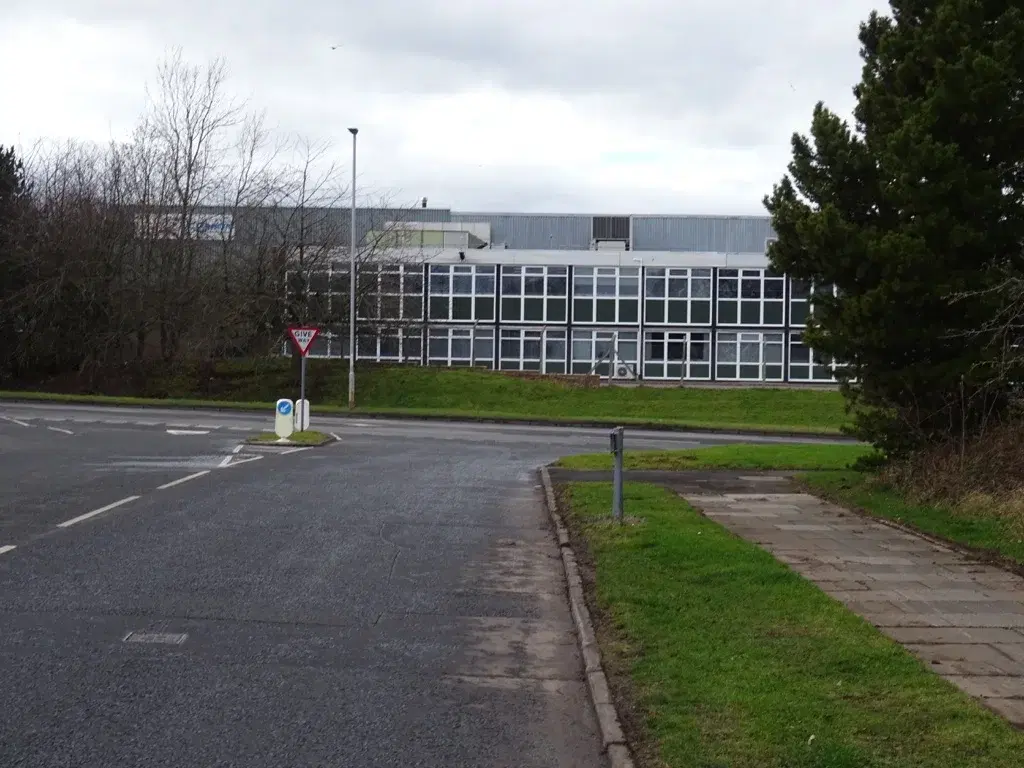
We started out to write about Cramlington in the Second World War alone, but found little that can be sourced: no record of bombing in the village, and an airfield that stood unused. So this guide covers both wars, and is honest about where the evidence runs out. Our photo shows the Bassington Industrial Estate, which now covers the site of the wartime airfield buildings.
Zeppelins over the village, 1915
On the evening of 14 April 1915 the German Navy airship L 9, commanded by Heinrich Mathy, crossed the coast near Blyth at about 7.45pm. The air-raid historian Ian Castle records that it dropped fourteen bombs in the area between Choppington, Bedlington and Cramlington. A haystack was burnt at Choppington, but the damage from the whole raid was estimated at only £55, and nobody was killed. (Ian Castle Zeppelin)
A photograph in Northumberland Archives, shared on Newcastle University's Co-Curate site, shows Cramlington residents beside a house damaged in a Zeppelin raid that April. (Co-Curate)
The airfield and the raids of April 1916
The raids are why Cramlington got an airfield. The Royal Flying Corps opened a station here in late 1915 to defend Tyneside, and No. 36 Squadron was formed at Cramlington on 1 February 1916. (NELSAM) Our guide to the lost buildings of Cramlington covers the airfield's buildings and its later life as a civil aerodrome.
The airfield itself was soon a target. On the night of 2 to 3 April 1916, the airship L 16 came inland over Druridge Bay. According to Ian Castle, it was first drawn towards Ponteland by flares at a landing ground there, then at about 11.50pm dropped five high-explosive and six incendiary bombs on Cramlington airfield. They "burnt some woodwork" but did little other damage. Two RFC aircraft went up after it without success, and one was wrecked on landing. (Ian Castle Zeppelin)
Best for: Cramlington airfield was bombed by a Zeppelin barely two months after its squadron was formed.
The death of Captain John Nichol
Three nights later the airship L 16 returned, and this time bombed Evenwood and the Bishop Auckland area of County Durham. Four RFC aircraft and one from the Royal Naval Air Service took off to intercept it. Captain John Nichol of No. 36 Squadron was killed when his aircraft crashed into a house at Cramlington and the bombs it was carrying exploded. (Ian Castle Zeppelin)
The Commonwealth War Graves Commission records Captain John Nichol of the Royal Flying Corps as dying on 5 April 1916, aged 22. (CWGC)
Cramlington's servicemen
Many men from the village and its pits served. Co-Curate's "Cramlington at War" collection gathers about 140 portraits of Cramlington servicemen published in the Illustrated Chronicle during the First World War, many of them in the Northumberland Fusiliers. (Co-Curate: Cramlington at War)
The village remembered them with the war memorial on Village Square, which the Imperial War Museums' register says was unveiled on 17 September 1922 by Lieutenant Colonel Robert Scott of Newton House, Lesbury, and dedicated by the Bishop of Newcastle. It carries 152 names from the First World War. One of them, R G Pattison, was only added in 2014. (IWM War Memorials Register) Our heritage walking trail starts at the memorial and describes it in detail.
The Second World War
By 1939 the airfield's flying days were over. Most civil flying had moved to Newcastle's new airport at Woolsington in the mid-1930s, and the gliding club that stayed on at Cramlington left when war broke out in September 1939. Cramlington was not brought back into use: Wikipedia records that the airfield was unused during the Second World War, and that the airship shed at Nelson Village was little used until after the war. (Wikipedia: Cramlington Aerodrome)
We have not found a reliable record of bombs falling on Cramlington itself in the Second World War, so we do not claim any.
The cost to the village was still heavy. The war memorial carries 55 names from the Second World War, alongside one name from Northern Ireland that was added after a 1994 article in The Journal. (IWM War Memorials Register)
There was also a separate roll of honour. The North East War Memorials Project records a British Legion Roll of Honour for 1939 to 1945, with 39 names of men who served in the Army, Navy and RAF. It was dedicated on 9 November 1947 by the Vicar of Cramlington, the Rev G B Fairhurst, and unveiled by Mr William Hawk in the Legion Hall at High Pit. Its present whereabouts are unknown, and the names survive because the Blyth News printed them on 17 November 1947. (NEWMP)
Best for: If you know where the 1947 British Legion roll of honour is now, let the North East War Memorials Project know, as its location is currently recorded as unknown.
Visiting the memorial
The war memorial stands on Village Square, a short walk from St Nicholas' Church, where the 18th-century table tombs in the churchyard are also worth seeing.
Further reading
For more on the airfield and the airship shed, see our guide to the lost buildings of Cramlington. Our interesting facts about Cramlington covers the 1926 derailment of the Flying Scotsman between the wars, and the Cramlington history timeline and heritage hub bring the story together.
Details were checked in November 2026. If you have family records or photographs of Cramlington in either war, get in touch.
Local businesses mentioned
Never miss what’s on
Join the weekly Cramlington.live digest — the best events, news and local tips, straight to your inbox. One email a week.
What's On
Remembrance Sunday in Cramlington
10:00 AM · St Nicholas Church, Blagdon Terrace, Cramlington NE23 6QQ
The Carrivick Sisters at Cramlington Folk Club
8:00 PM (doors 7:30 PM) · The Benedictine Social Centre, Glenluce Drive, Southfield Green, Cramlington NE23 6YA
Wilder Wellbeing at Northumberlandia
11:00 AM - 2:00 PM · Northumberlandia, Blagdon Lane, Cramlington NE23 8AU